



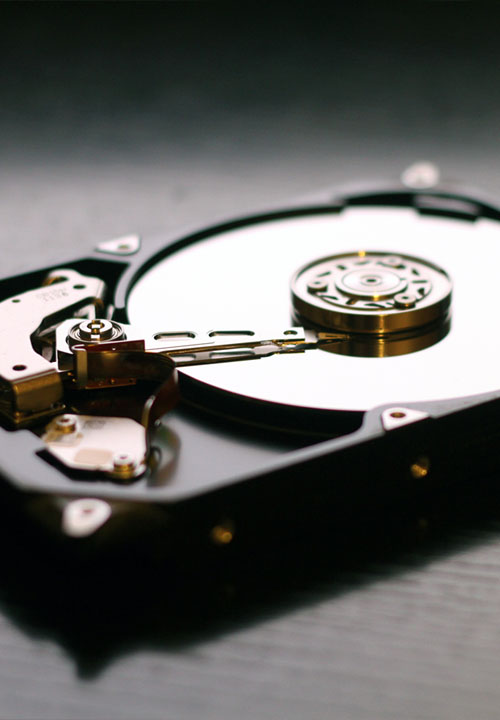
Invented in 1956 by IBM, at the request of the US Air Force, the first hard drive was the Ramac 305 (Random Access Method of Accounting and Control). It consisted of a set of 50 aluminum disks with a diameter of 61 centimeters.
They rotated at 3600 revolutions per minute and were covered with a thin magnetic layer, allowing a total of 5 million characters to be stored (i.e., 5 megabytes).
This first disk offered a transfer rate of 8.8 KB/s and weighed more than one ton!
Since these beginnings, the hard drive has continuously evolved to become one of the most widely used backup storage media in the world. It is therefore composed of a stack of several platters. The surface of each platter is covered with an active magnetic layer. A head moves across the surface of the platter and modifies the local magnetic field.
Today, data access depends on the rotational speed of the platter, which ranges from 3600 to 15000 revolutions per minute. Data can be accessed quickly and a disk can contain several TB. Read and write times are quite good. It is also one of the media with the lowest cost per GB.
Regarding reliability, we are dealing with a clearly proven technology. The most problematic point is certainly the read head, which is a moving part sensitive to wear and shock. Manufacturers claim an operating lifespan of over 1000 years. The reality is quite different.
Several studies have been published on disk failure rates in real environments: Disk failures in the real world, Backblaze [1][2][3] or Google.
Archiving specialists estimate an average lifespan of 5 years. According to the Google study on 100,000 hard drives:
- The failure rate during the 1st year of operation is 1.7%, 8% in the second year and 8.6% in the third.
- The SMART system promoted by manufacturers is not as effective as claimed.
- Disk temperature or disk activity level is not a major factor in failures.
- The main causes are related to vibrations or manufacturing defects.
According to Backblaze, some manufacturers are more reliable than others; for example prefer: HGST (Hitachi) over Seagate or Western Digital. The MTBF (Mean Time Between Failures) factor is an estimated disk lifespan provided by the manufacturer. This factor (often announced as more than 1 million hours) is greatly exaggerated.
In the event of a failure, and beyond standard backup technologies, it may be necessary to use data recovery software.
The hard drive has become the backup medium par excellence. Very widespread, it is based on a proven technology, with high transfer speeds and easy access to all data on high-capacity disks.
Its price per GB is among the lowest on the market.
Its main drawback remains its sensitivity to shocks and its average lifespan of 5 years.
Longevity and reliability
Accessibility and practicality
Transfer speed
Security
Price/GB